



Tips for Car Rental in Namibia
Car Rental in Namibia
- Overland / vehicle
Together with my girlfriend Hadas, we set out in October 2015 for a half-year trip across the continent. We started in Uganda and made our way all the way to South Africa via Tanzania, Malawi, Zambia, Botswana, and Namibia.
Feel free to reach out with any questions!
Ziv – 0524343480
Car Rental in Namibia
Namibia is a wonderful country, and in large parts of it, it feels as though you've landed on another planet.
Although the country is very developed compared to other countries in Africa, because the population density per kilometer is among the lowest in the world, public transportation is not very developed and the most common way to explore the country is by car.
As a result, the common accommodation options in the country are usually campsites that provide very well-maintained restrooms and showers, a food preparation area with a tap, and a spot to light a campfire. These places operate under the assumption that you travel with a tent, your own food, cooking equipment, and sometimes even a table and chairs.
Which car should you rent? 4X4 or regular?
The most common vehicle in most rental companies is the Toyota Hilux, which comes in models for two or four passengers. It's a 4X4 pickup truck with a large enclosed trunk, and if you want, also a rooftop tent. There are many vehicles similar to the Hilux, and the differences between them are not very significant.
Like everywhere, there is also the option to rent a small car, which is a dilemma that comes up to cut costs.
Driving in Namibia in a small car is possible – meaning the main roads in the country are paved and very good quality, some of the side roads are also paved, and even on dirt roads it is possible to drive in a small car.
However, it is very important to mention a few drawbacks – first, the equipment issue. As mentioned, most places assume you are traveling with a lot of gear. A small car also has a small trunk, so you won't manage to transport everything, and in the end, it means either sleeping in rooms, which is sometimes a much more expensive option, or giving up on many things in terms of comfort. Additionally, as mentioned, you can always manage in other ways, but there is something fun in Namibia about choosing remote and desolate roads, and you would miss out on that experience.
For someone who is planning to sleep in rooms anyway and is not drawn to wild driving, this is a reasonable option.
The Insurance Issue
Every company charges a different price for insurance, but the whole thing always seemed strange to us, so I'll try to explain.
You will see a table that looks roughly like this:
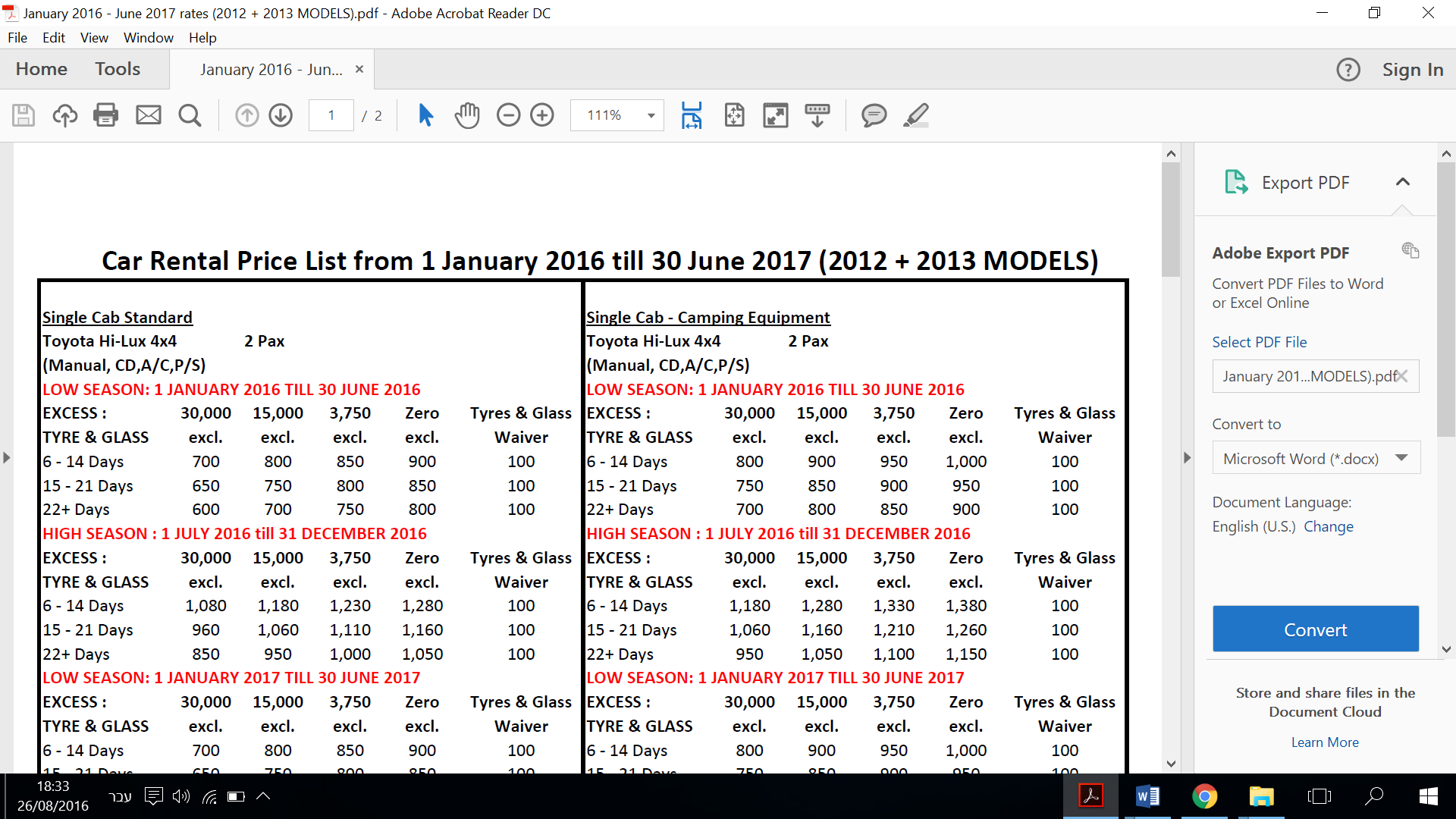
What appears at the top from left to right is actually insurance tiers. The number 30,000 represents the maximum deductible amount; this is usually called taking it "without insurance". Then, for each tier, there is a daily rate versus a maximum deductible amount. And full insurance (Zero Excess) will cost accordingly.
In the middle, we see the daily rates we will pay, according to the different insurance tiers.
In most companies, there is a separation between windshield and tire insurance and insurance for everything else, as shown in the table. This means that even if you took full insurance, to insure the windshield and tires you will need to pay an extra 100 Rand written on the side. On the other hand, it also means you can insure only the windshield and tires and not take regular insurance.
So what is recommended to take?
Whether to take full insurance or no insurance is completely your decision – full insurance will give you peace of mind during the drive, and taking no insurance will save you money; this is a decision that can be made right at the moment of signing. In any case, most rental companies also strongly recommend taking the tire and windshield coverage.
In my case, we intended to take full insurance, but at the Advanced Car Hire agency, Karla the manager convinced us there was no need (since we were trying to reduce costs) and that what mattered was the windshield and tire insurance. In hindsight, this turned out to be an excellent decision: we got a crack in the windshield, a rear window popped out of place, and a flat tire – while on the other hand nothing happened regarding general insurance.
What is important when making the decision is to clarify with the company you are renting from what exactly the insurance covers. Usually, there will be items it does not cover, such as the chassis and clutch.
How do you manage with navigation? Fuel? Food?
So as mentioned, Namibia is the perfect country for a road trip. Everything is well signposted, and anyone who likes opening a map and figuring things out will have no trouble navigating. Anyone who wants the convenience of GPS will find that every rental company offers one.
Regarding fuel, there are sometimes long stretches without any, so it's best to be on the safe side and fill up whenever you pass a gas station and the tank is half full or less. It is important to know that fuel tanks in Namibia are enlarged in most vehicles to huge tanks of around 150 liters, and accordingly you can cover many kilometers on a full tank.
Regarding food – you won't pass a huge supermarket with everything every day, but it is expected to happen every two or three days, so it's advisable to stock up a few days in advance.
So how do you even approach renting a car? Which company should you rent from?
So Namibia made our life easy and created an association of all approved car rental companies, so with a simple email you get price quotes from all companies. The email is sent to this address:
They usually reply within a few days.
For those traveling during the summer months up to October, this is a relatively busy time, so it's advisable to book vehicles in advance.
Special offer for Mzungu backpackers!
10% discount for Advanced Car Hire
10% discount for Africa 4X4 Rentals
For more details click here