





Gondar
Third time injera - Gondar
- Independent / backpacking
I dedicated a year to myself, travelling and exploring Ethiopia and North-East India (the Seven Sisters). During this year, your tips and those of many others accompanied me in times of distress and when I had no source of information. With great appreciation, I wanted to share a few things I learned myself. Enjoy reading.
During the trip (not including my time in Ten Project), I stayed for about two and a half to three weeks in the city of Gondar. Every day passersby asked me what I was doing in a city where there is almost nothing. Honestly, I had nothing to answer. It all depends on how much you try to get to know people and connect. I can say for myself and Enbali (my travel partner) that every day we woke up in the morning without knowing a single thing about what we would do after brushing our teeth, but after going out to eat ful, or tea and bambolino (the local pastry), our day became so busy and we had no idea when it happened.
A bit of Wikipedia - "Gondar is a city located in the North Gondar Zone of the Amhara Region in northern Ethiopia. Gondar is located about 30 km north of Lake Tana and southwest of the Simien Mountains. The city was historically the imperial capital of the Ethiopian Empire and was often referred to as 'Gondar Province'. Today Gondar is a regional center and a tourist city featuring the historic royal enclosure, Fasil Ghebbi, declared a UNESCO World Heritage Site in 1979. Gondar is also a religious center for the Ethiopian Orthodox Church. Gondar is known in Israel because most Ethiopian Jews who immigrated to Israel lived in the surroundings of the city. Today a few Jews still reside there."
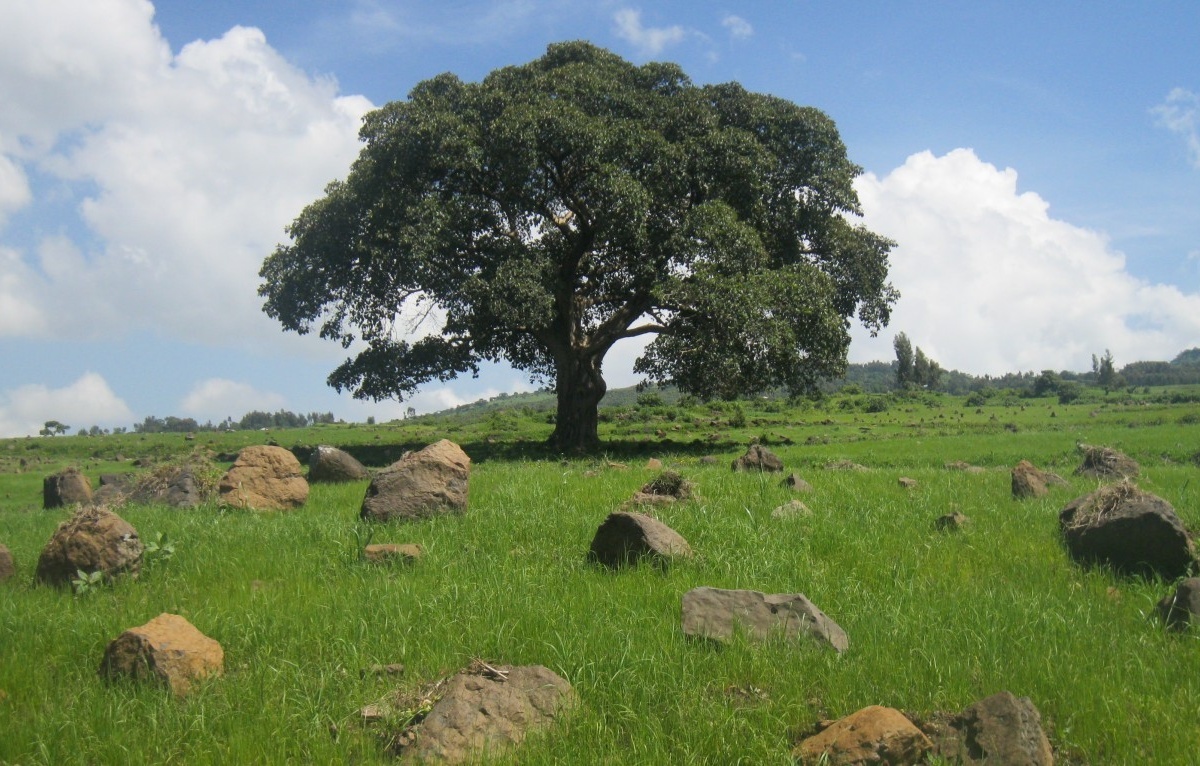
What happened to me there?
About a year and a half ago I flew to Ethiopia through the "Ten" Project of the Jewish Agency. As the plane's wheels touched the green ground, my endless love affair with this magical city began. I stayed in a nice neighborhood in a charming house with 16-17 volunteers for six months. There is no need to tell about the volunteering period because it doesn't match the backpacker experience, so I'll skip to packing the bags before going home, thinking about my next visit.
Exactly one year later I landed in Gondar with a backpack and a slightly different story. This time I wasn't excited at all about landing because I was unconscious on the plane with a 40-degree fever and only those close to me knew what else... A local girl found us at the airport (in Addis, where we flew to Gondar from) who studies in Addis but was flying to her family for the holidays (Enkutatash – the Ethiopian New Year, and Meskel – the Finding of the True Cross). One thing led to another, and dizzy from the whirlwind, Enbali and I found ourselves on the living room sofa of that girl who met us at the airport, with her whole family (and believe me, they are many) surrounding us and urging us to feel better. This was right after returning from the hospital with suspected appendicitis (which turned out to be a hungry bacterium that decided to eat me from the inside). The wildest coincidences always led us to those magical moments, including – a local family adopting us. So in the Kebele 3 neighborhood near the Piazza, we lived for about two weeks. We slept, ate, and spent time with the family. Of course there were occasional breaks when we felt overwhelmed, or if we felt like going out to dance Eskesta (the traditional dance) in the evening, and rested our heads at Michael Hotel, which took good care of us.
We celebrated the holidays with the family and local friends. The first among them was the Ethiopian New Year – Enkutatash (meaning of the word: a small yellow flower covering the ground at this time of year), which we started in the morning with animal slaughter in the courtyard (not by us, of course). A goat we petted yesterday was hanging peeled like a banana on our doorstep, and at the entrance to the bathroom the uncle was chopping off chickens' heads. We immediately shut the door, curled up, talked about veganism and how cruel the world is. Believe it or not (apologies in advance to vegetarians and vegans among us), we ended the day with the animals inside our bellies. I have official proof, I saw everything, and I will probably never be a vegetarian...
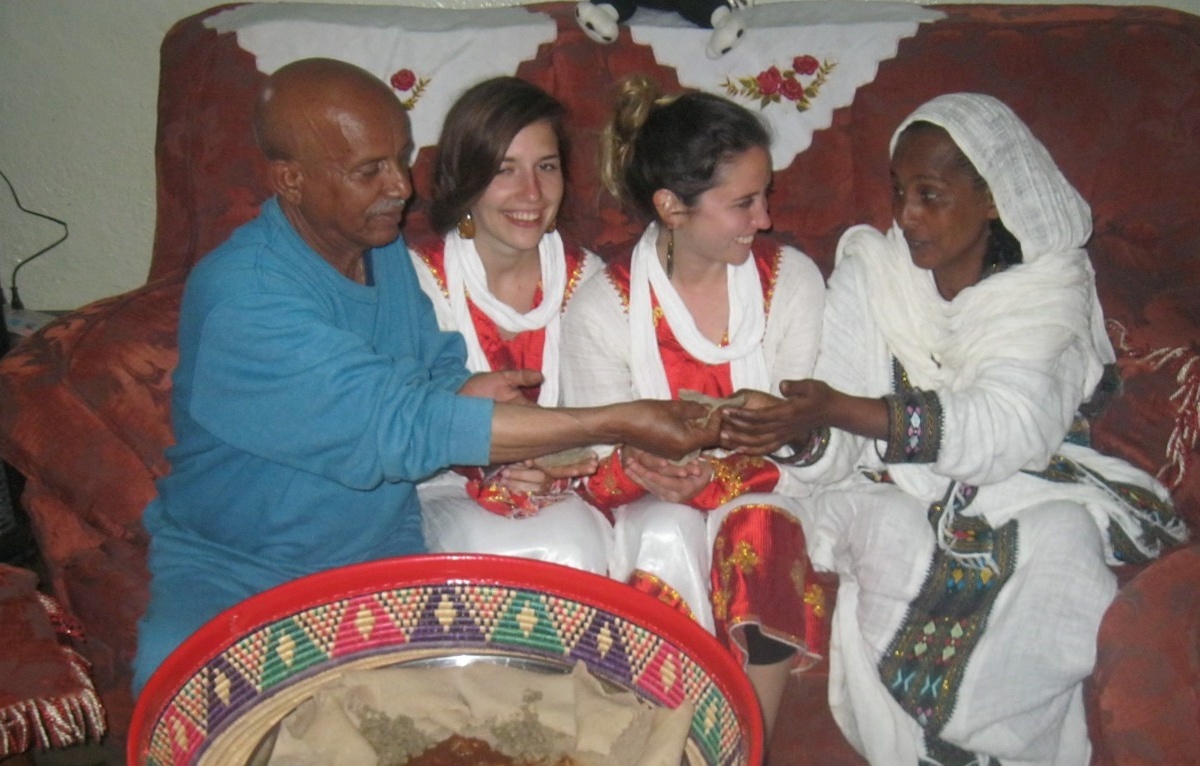
Between the start and end of the day, a few more things happened. First – they dressed us in beautiful traditional clothes and for some reason trusted us to take care of them (honestly – we succeeded!). Second – one of the sisters turned out to be a talented photographer and showered us with photos, the weird Farangis (foreigners) in traditional holiday clothes. If one day I am discovered as Roberto's new face, it's only thanks to her. Third – we went out strolling wearing the holiday attire. We met friends, enjoyed a mild buzz from the local beer, and danced. And last – we noticed we were late for dinner, so we returned. And here I am writing again about the wonderful holiday dinner filled with good things. We went through a family ceremony where the head of the house gave us a gursha (gursha – feeding injera directly into another person's mouth as a sign of affection and love) and we laughed out loud until we couldn't breathe.
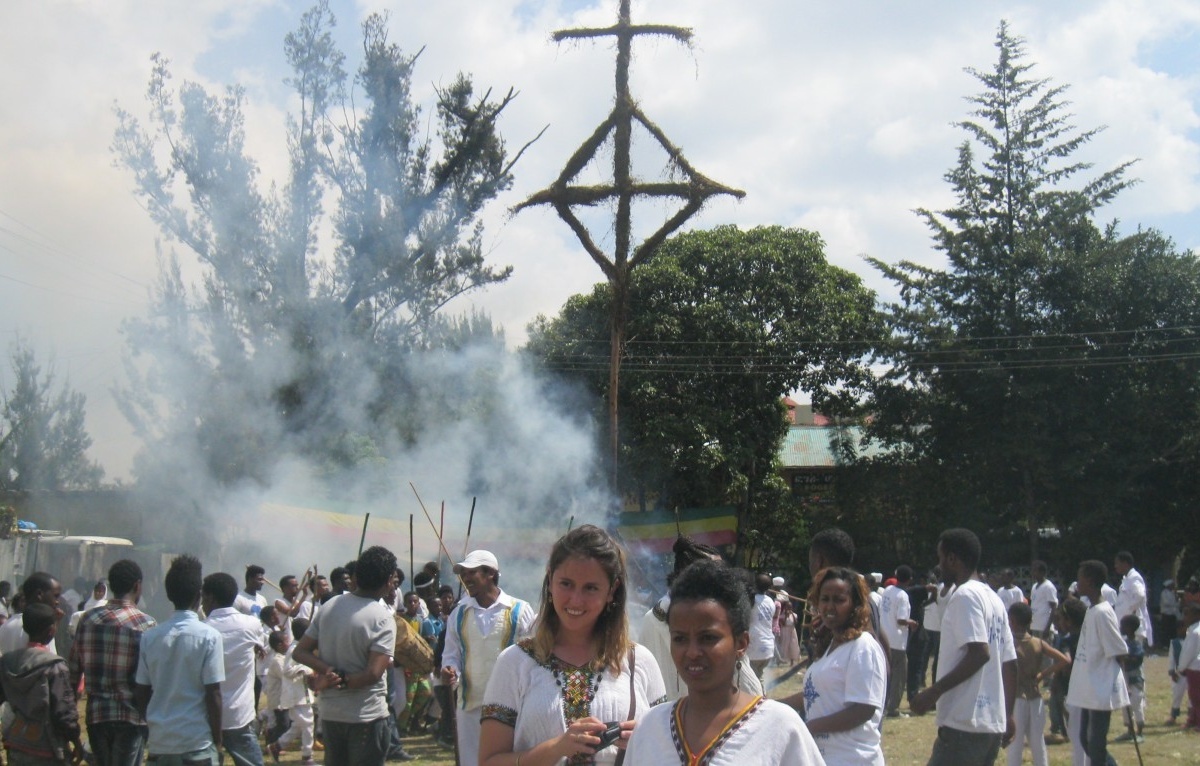
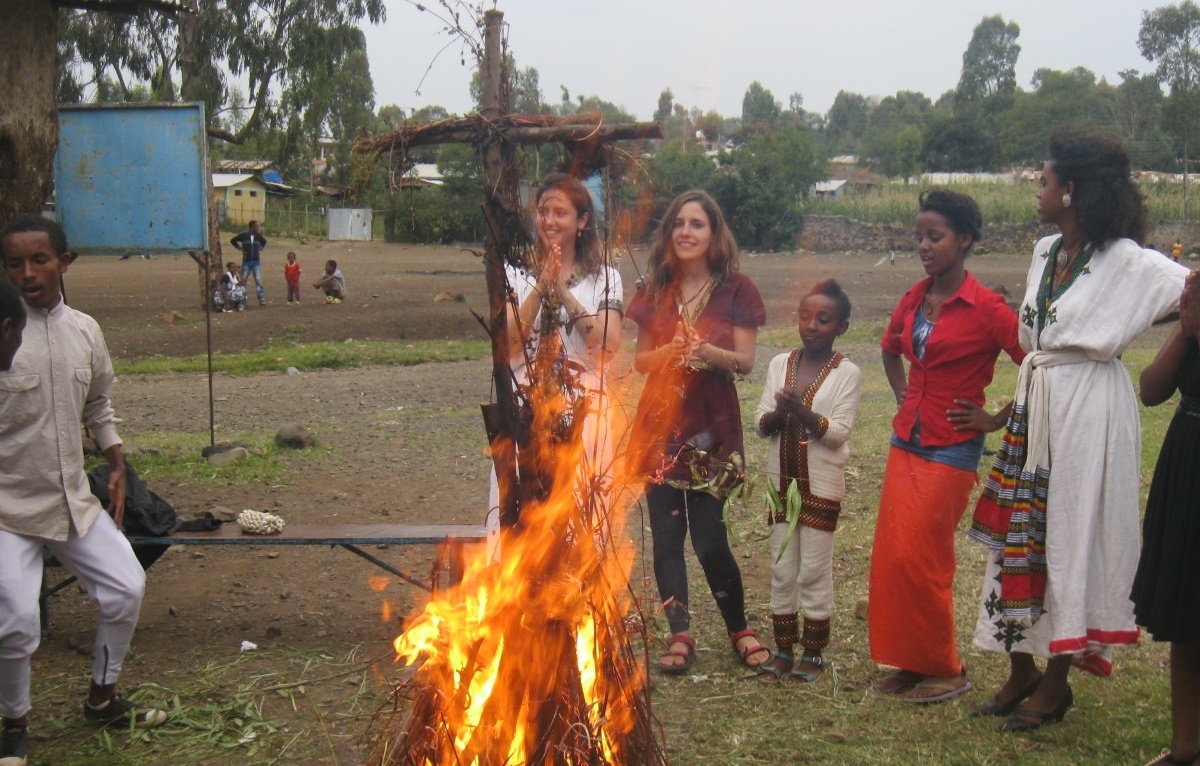
The second holiday, Meskel – a very mystical holiday where you wake up at 4 in the morning, get ready, and go out when it's still semi-dark outside and everything is smoky. Why smoky? Outside every house stands a cross built the day before by a family, made of twigs and wood. In the morning (while still dark), families set fire to the cross until it burns down completely and falls. We walked from Michael Hotel to the family's house, gasping for air. They welcomed us with popcorn and shai (Ethiopian tea), with all of us dressed in traditional clothes again, just as I like. Later it was our turn to burn a cross too. During the burning process, the whole family runs in circles around the burning cross and sings traditional songs until it falls. It is not an occult ritual, despite how it sounds, but a tradition symbolizing the finding of the Cross of Christ. Later we went with the sisters to the Piazza, where the main ceremony takes place. We went up to the VIP area (for Farangis only) together with our new sisters and watched the proceedings from above. Honestly – deadly boring, but just for the excitement of sitting in that honored spot it's worth a few minutes there (we sat near the Pope!!!). When we started rotting from boredom, Inbal and I went to celebrate with our friends in a more distant neighborhood – where another, more humble ceremony awaited us with drinks, music, and dancing. We ended the day with "sigh, why is this day ending damn it" and went to sleep.
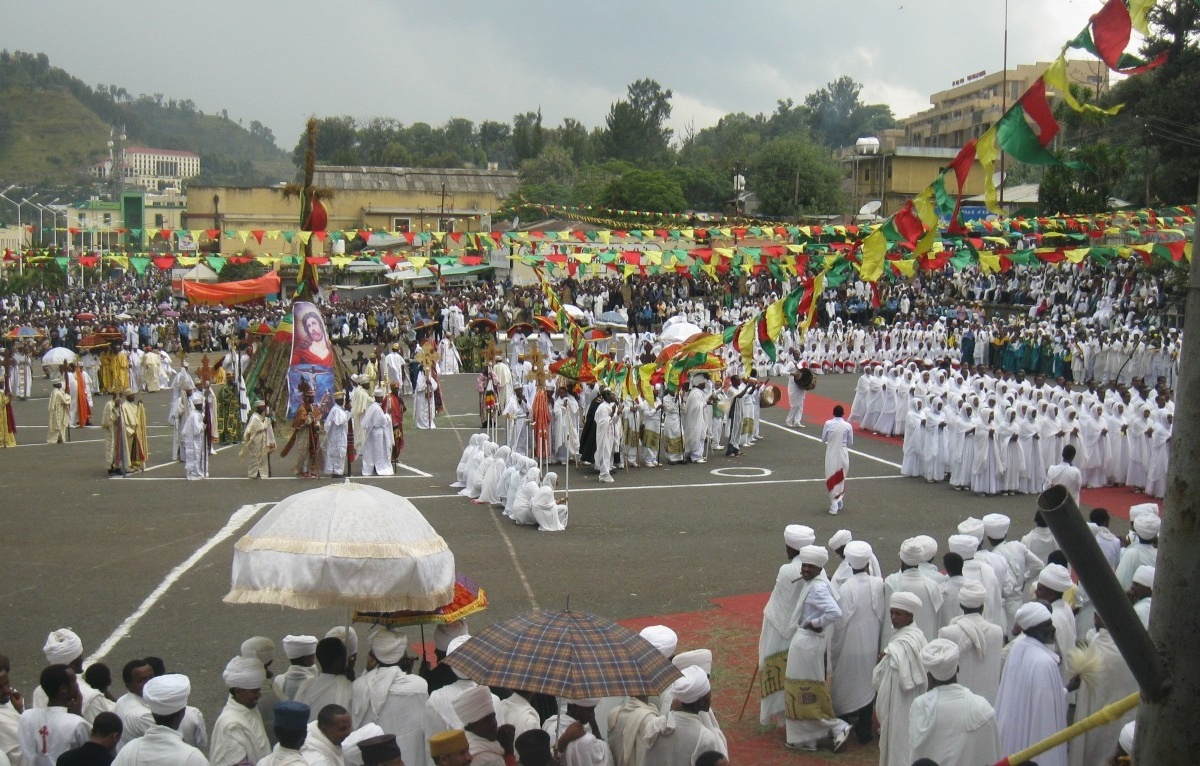
So that's a concise summary of what I did there, and below are additional things to do in the city-
City attractions:
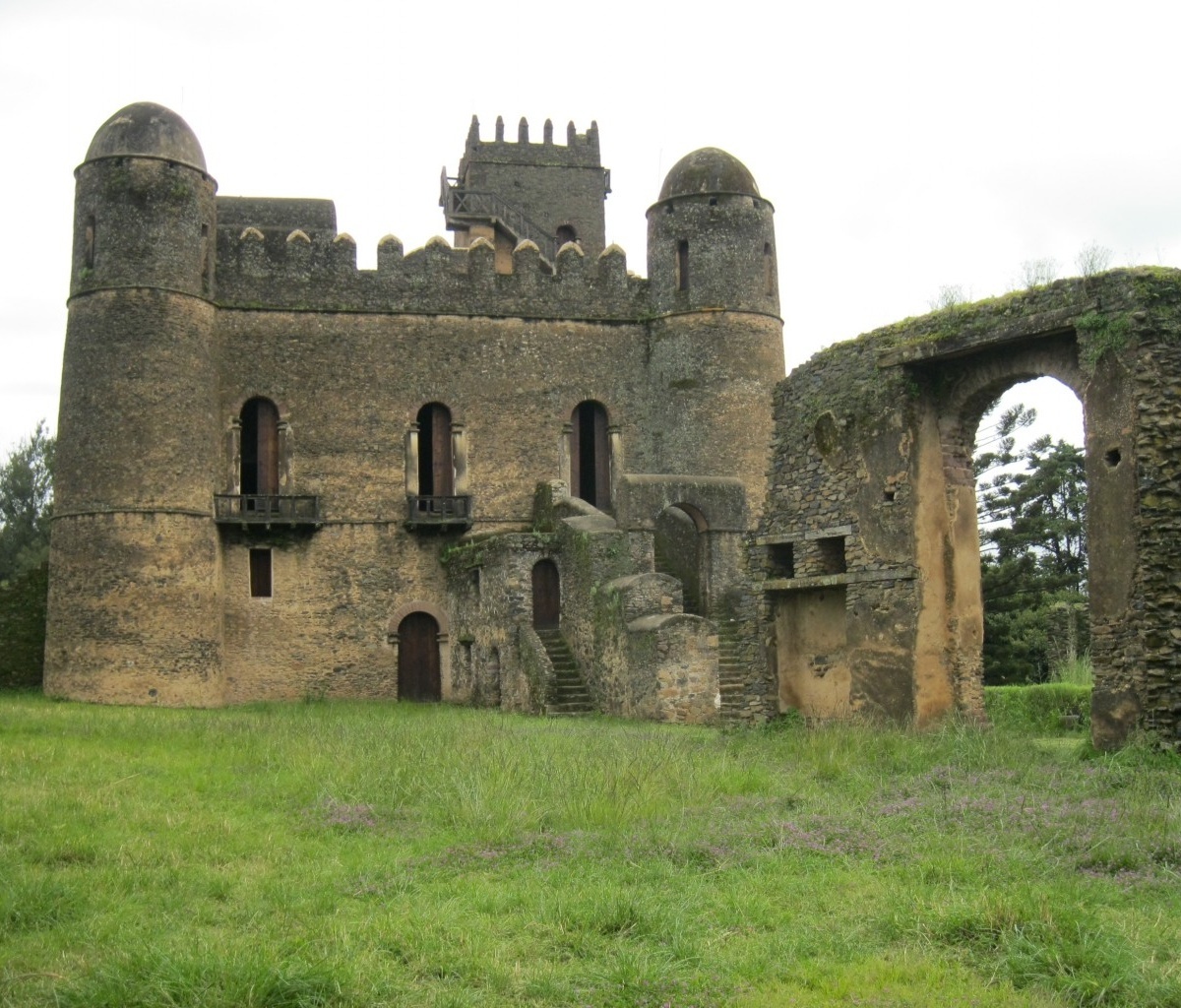
Fasil Ghebbi – an impressive and magnificent palace built by Fasilides in the 17th-18th century.
The Jewish Synagogue in Kebele 16: It's best to arrive before Shabbat enters, during it, or when it ends to feel the Jewish community and share the emotion with them. The synagogue is located in the Kebele 16 neighborhood. The easiest way is to take a taxi from the Piazza to College Road and get off at the Helmerger Hotel. The synagogue is up the street on the right hand side and inside an alley, so it isn't visible while walking. It's recommended to ask at Helmerger where it is (hotel staff know) and get directions from them. By the way, Helmerger Hotel serves Kosher food.
Arda – the local market. From the Piazza there are taxis and bajajs going there, and you can even walk in 10 minutes. I recommend taking a bajaj – it costs 1 Birr per person and drops you right at the market entrance. It's nice to wander around and feel the atmosphere.
Culinary experiences:
Go eat a "ful" breakfast on College Road. Take a taxi from the Piazza passing through College Road and ask to get off at Mezoria (around 1.5 - 2 Birr per person in my opinion). At Mezoria, on the other side of the road, you'll see plenty of stalls, and among them women one after another preparing a red dish emitting a great smell. Order "ful", drink shai, and just enjoy! (a bit spicy)
Want to get used to local food? But slowly because you're scared? My first injera was at Quara Hotel in the Piazza. A nice hotel and the restrooms always have paper (if I didn't steal it before you came). Ask for shiro tegabino with lots of garlic. Taste it! Cheap and feels great in the mouth. (quite spicy)
Tele-Cafe restaurant is not hard to find at all. Right under the telephone company building is the restaurant, and everything I tasted there was delicious.
If you're meat eaters:
Ask locals where to find good "tibs".
If you're invited to "doro" (chicken), don't say no.
Dashen Beer Garden – unfiltered Dashen beer for 11 Birr (half a liter) can only be found there. Right as you enter Azzo neighborhood in Gondar, there is a beautiful garden in the yard of the famous "Dashen" brewery. You can order only beer there – you won't find Coke or even water... food is available sometimes. If they have chicken – order it. Wow. I have no words.
If you're in a fancy mood today:
Hike up to "Goha Hotel". Eat a wonderful Western meal there with a macchiato and ice cream for dessert. How to get there? At the Piazza roundabout go left. Ask people how to get to Goha Hotel and they will guide you. Basically all you need to do is keep along the road. As far as I recall, a bajaj should take 2-3 Birr per person (to the station before the climb!!! not including the climb). I always walk up because I feel like a couch potato that never stops eating in Gondar, so it's my exercise to relieve the heavy feeling. Arrived? Enjoy the view over the entire city and pamper yourself with food.
Or
Go to the upscale 4 Sisters restaurant. Although this restaurant isn't expensive at all, back then the price was 100 or 150 Birr, today the price went up to 200 Birr – all-you-can-eat buffet from the tastiest buffet in Ethiopia. Don't be shy, check out the buffet before deciding. – don't forget to fast for two days beforehand!!
Street fries + samosa: If you're a fan of greasy street food – this is for you. Mostly you'll encounter street fries and samosa stalls on College Road, or in the afternoon in Azzo neighborhood (which honestly, you have no reason to visit...). Be careful - street fries are addictive.
If you want to get closer to the roots, try blending into the local crowd and finding dark, hidden spots. Look for them. If you don't want to risk meat – order shiro tegabino or beyaynetu.
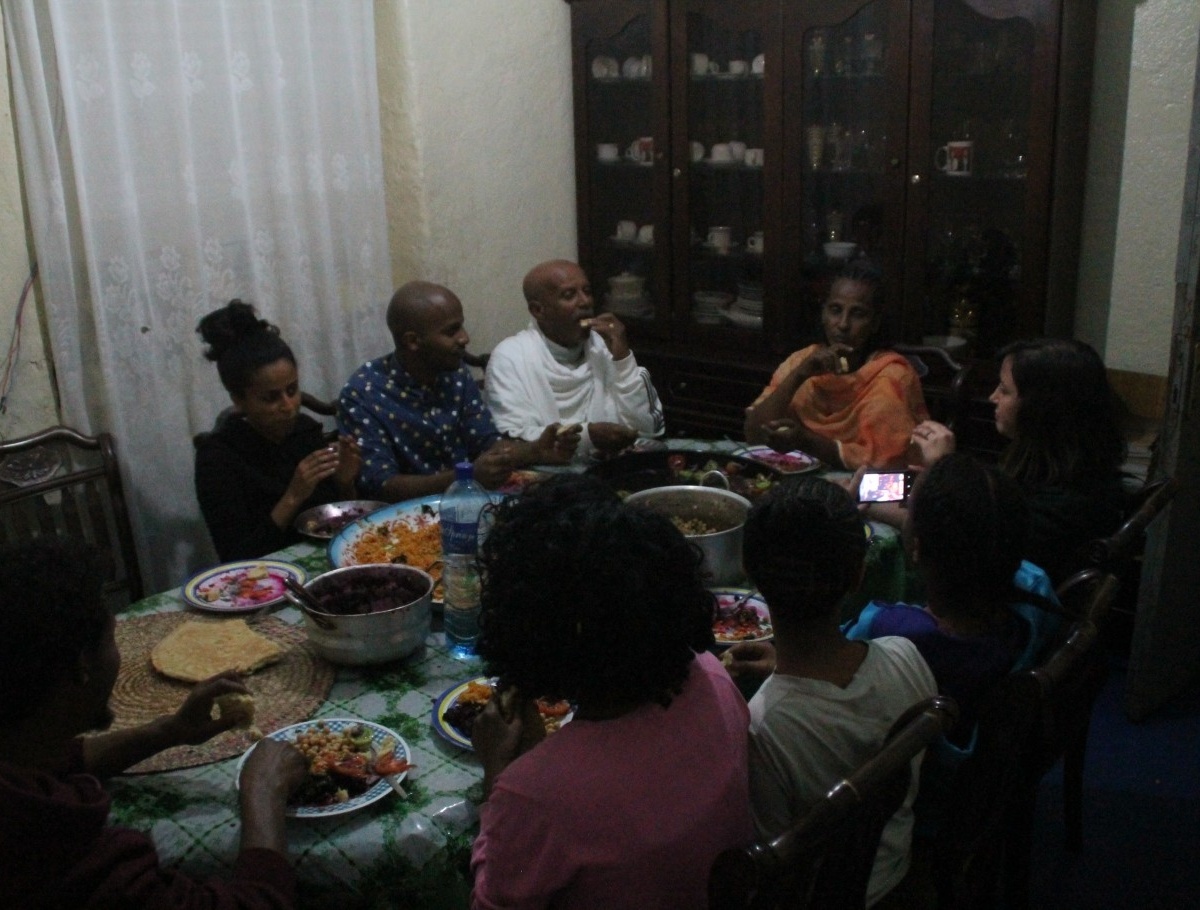
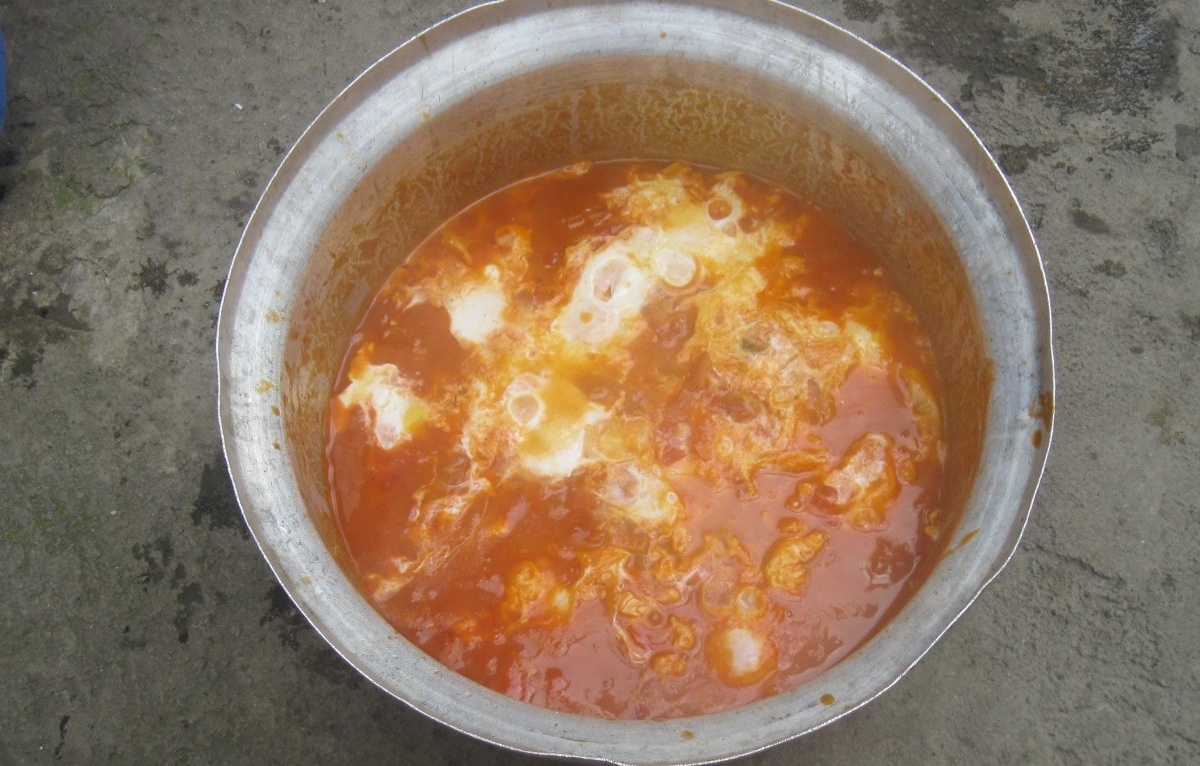
Local shakshuka :)
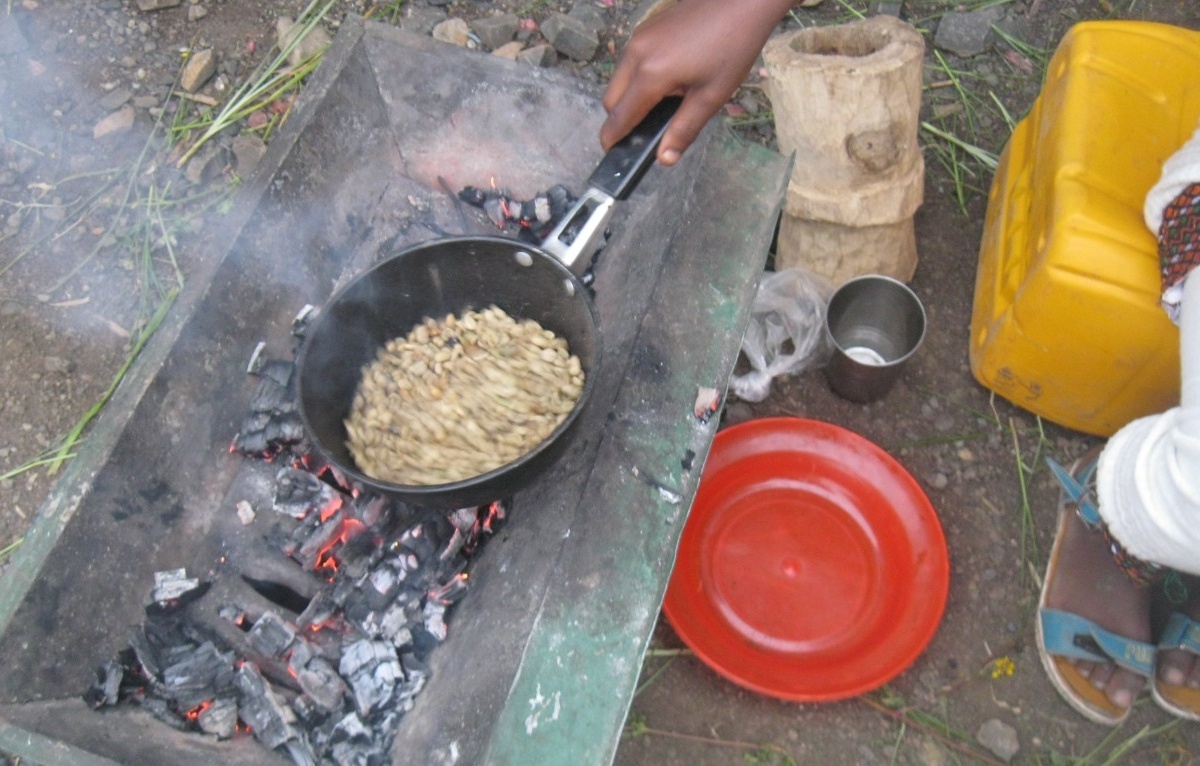
Buna (Ethiopian coffee)
Where to sleep?
Michael Hotel in Piazza – 250 Birr.
In case there's no room – Al Shape (neighbor of Michael Hotel) at a similar price.
Comfortable and clean places. High standard. Recommended.
Getting around:
There are blue taxis leaving Piazza all the time (from 6 AM to 8 PM in my opinion) going through two main streets ("College" and "Hospital") and reaching Azzo neighborhood – the other end of Gondar. Price range in a blue taxi is between 1 Birr up to 5 Birr (to the last stop) per person.
You can also travel by bajaj – small tuk-tuks that will go anywhere you ask them to.