


Why Not Uganda?
Why Not Uganda?
- Independent / backpacking
I'm Yael, 26 years old, and I travel in Africa and around the world alone. Sometimes I meet a fellow traveler and spend a few hours or maybe a few days with them. Most of the time in Africa, it was actually locals I traveled with, spending time hiking and talking together.
I love nature and always sleep on the ground – in my small tent or simply under the open sky.
My great love today, and always has been, is nature and hiking. Africa added people to that mix too!
Travel, and Africa in particular, changes me into a softer, more accepting, and most importantly – happier person.
Every day brings something new and exciting, and each day is a world unto itself. Sometimes happy things, sometimes sad, sometimes just funny and absurd. But every day shapes me anew.
This article is part of a series of three articles written by Yael about Uganda and published on her travel blog
"Yael Goes Traveling"
More articles in the series, in the drop-down menu—here.
Mount Elgon and others, Uganda-
There's a new wave in the family, and as I prepare to leave South Africa, two of my brothers inform me they are joining me for a short trip in Africa. Destination: Uganda – flights are relatively cheap, close to Israel, a small and compact country with various travel options, stable security situation, my growing longing for East Africa, and basically – why not Uganda?!
Before they arrive, I want to prepare the ground and get to know Uganda deeply. I endure a arduous journey to Uganda, across shady borders and using various modes of transport, but finally cross over from Tanzania and head straight to Kampala, Uganda's capital.
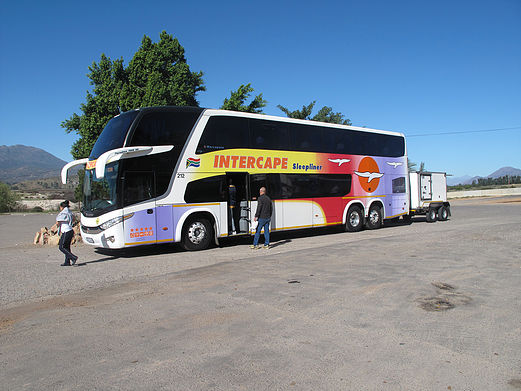
The bus from Cape Town to Namibia, on my way to Uganda
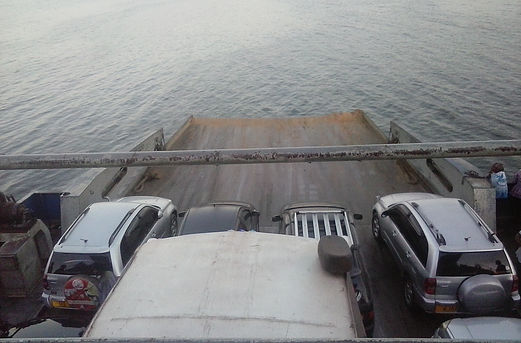
Ferry on Lake Victoria, on the way from Tanzania to Kampala
I imagined the city would be crowded and bustling, poorly planned and built, similar to other big African cities. I imagined streets packed with cars, people, and shops, somewhat like Nairobi – walkable, but at certain hours extremely crowded, especially in the evening when people finish work and vendors selling clothes, household items, and food pop up on every corner and available patch of sidewalk. But Kampala turned out to be much tougher than I had ever imagined.
I arrive in the city at night, when it's already dark, after the bus broke down for several hours on the way. It's never pleasant to arrive somewhere in the dark, no matter how safe it is or how well I know it. In Kampala, neither of those applied.
The city isn't considered particularly safe at night (though not as dangerous as Nairobi or Johannesburg), and I didn't know anything in it. I didn't know where the bus would drop me off or where to start looking for a hotel to sleep in.
I join a Tanzanian guy named Chacha who leads me to a hotel in the busiest and noisiest part of town. You can't get more central than this. The price is cheap and the conditions reflect that. I promise myself to leave this place as soon as I find an ATM and make sure I have enough cash to pay for a hotel where I can feel safe.
I strike up a friendship with the receptionist, a young guy named Medi, and learn that he is originally from Ethiopia. I wouldn't have guessed it because his skin tone is dark black and he is very tall, whereas most Ethiopians I had met had light brown skin and were relatively small in stature.
Medi explains to me that he comes from a place called Gambella, in western Ethiopia near the border with South Sudan, which is why he looks more Sudanese than Ethiopian. This was an area I was advised not to visit due to the poor security situation. Back when I was in Ethiopia, 75 students were killed in a major protest in that region of the country.
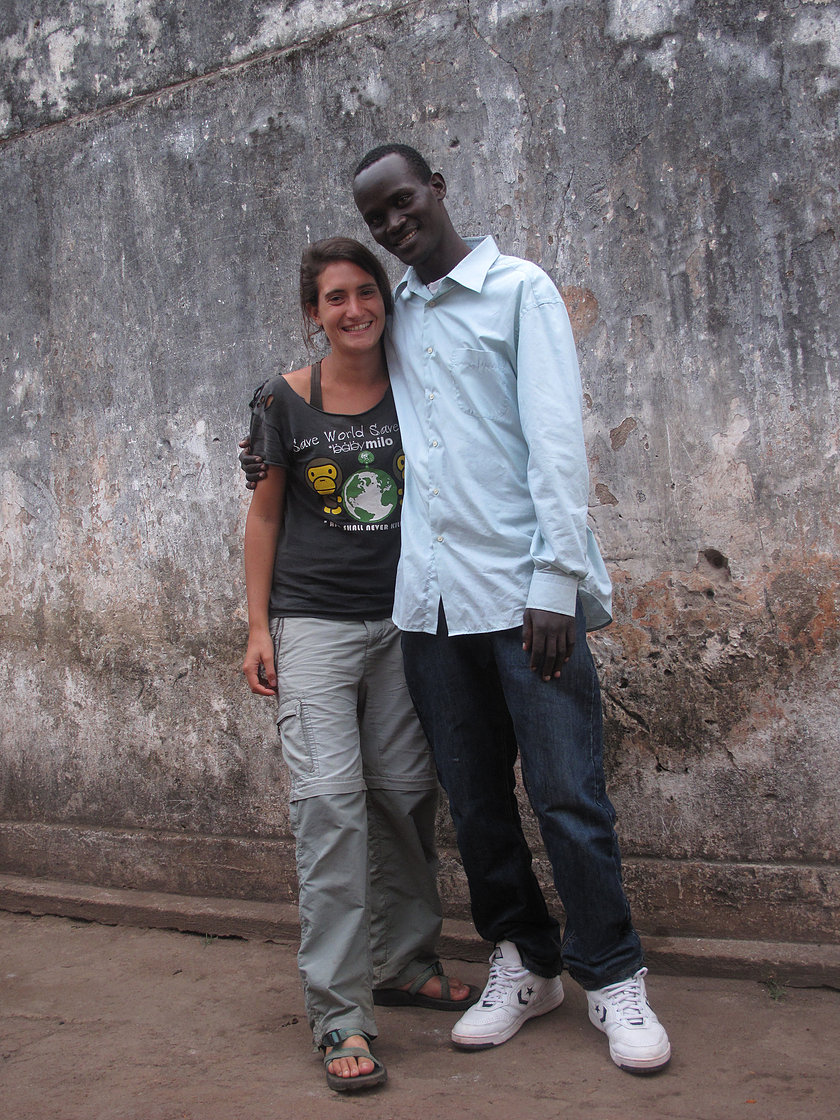
Medi and I
Medi and I
So what is he doing in Kampala? Did he migrate here hoping to make money or move on to America? Many Ethiopians dream of that but struggle to leave Ethiopia because of strict visa requirements for Ethiopians to almost any country in the world (including African ones). It turns out Medi came to Kampala under different, harsher circumstances, and largely not by choice. According to him, the Ethiopian government committed genocide against his tribe in Gambella in 2003, forcing him and his family to flee Ethiopia to South Sudan. From 2003 (when he was only 11) until 2013, he lived in refugee camps in South Sudan and northern Uganda. His father, a doctor by profession, was arrested at some point, imprisoned in South Sudan, and only recently released. Medi speaks of his father with great love and admiration, but also with criticism for taking two wives and having eight children with them, while being unable to support them all. He shows me a picture of his father and says, "He is an old man now." "How old is he?" I ask. "About 45 – an old man," he answers me.
His mother decided to return to Gambella a few years ago with some of his younger siblings, while he and his aunt (a young woman his age, his father's younger sister) received refugee status in Uganda and are legally allowed to stay, though they lack civil rights in the country.
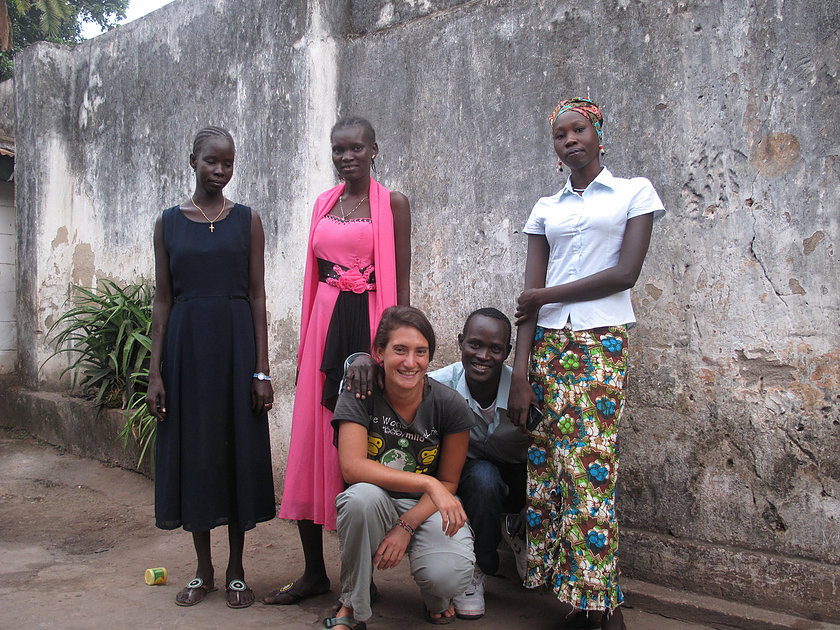
Medi and other relatives in Kampala. His young aunt on the right
In many conversations I will have with Medi later, I learn many more details about him: about his past and present life, and about the Ethiopian government's attitude toward minorities and even toward major groups (like the Amhara and Oromo) in the country.
He longs to study medicine but hasn't even finished 12 years of schooling yet. He wants to resume his studies, but to do so he needs to pay tuition fees, and on a salary of 200,000 Ugandan shillings (equivalent to about $70), he can't save anything. When I suggest he return to Ethiopia to study, where tuition would be free, he says the Ethiopian government prevents members of his tribe from pursuing education. If they find out he's from Gambella and getting an education (especially higher education), something terrible might happen to him (imprisonment, murder, etc.) or he wouldn't be allowed to stay. Getting a job in government offices or public service is completely out of the question.
His current job in Kampala, at this central hotel, saved him in many ways because it provides him with a place to sleep (not a refugee camp), a salary (even if tiny), and many Ethiopian friends – the hotel owner is an Ethiopian businessman, and most workers there are Ethiopian refugees. He is a pleasant, polite, and intelligent guy, but stuck in a reality hard to escape. He is confused himself, sometimes talking off-topic, repeating himself often, and completely inactive.
He keeps repeating that God saved his life and God will decide his future now, as if he has no part in that decision. We "hang out" together in Ethiopian restaurants and cafes – eating Injera and drinking Buna (Ethiopian coffee), and I am amazed by the size of the Ethiopian community living in Uganda. Did they all flee the terrible Ethiopian government? Or did many move here by choice, seeing Uganda as a better place to live? This is a completely different face of the Ethiopia I knew and loved. There are so many things we don't see as temporary visitors to a country. I knew life in Ethiopia wasn't easy, but I didn't know the government persecutes its residents, creates so many difficulties, and carries out deliberate killings against certain groups. In Ethiopia, there are several ethnic groups, and the dominant one is the Amhara, even though they are not the majority. This causes a lot of friction and severe oppression. One of the Ethiopian workers I meet at the hotel is from Gondar (the origin of Ethiopian Jews in Israel) of Amhara descent, and even he tells me, "The Ethiopian government is no good." I will later experience the severity of the Ethiopian government firsthand, though fortunately for me, it was not a matter of life or death and had no lasting effect on my reality.
So what is really going on in Ethiopia? Every time I meet Medi and his Ethiopian friends, I feel a heavy sense that I missed seeing these severe problems in the country – that perhaps I turned a blind eye, or was completely unaware of such crucial issues. While it doesn't change the fact that I met warm, good, innocent, and friendly people in Ethiopia, still...
The morning after arriving in Kampala, I head out on my first mission – finding an ATM; what are we worth without money?! This is my first foray into the tough street, and I actually have no idea where I am on the map. I muster my courage, step out into the world, and start wandering the city. I walk around for about an hour in this crazy city until I find an ATM and manage to withdraw money (not a given in third-world countries). A sigh of relief. From there, life gets easier – I move to a decent hotel, get a local SIM card, and after a few days of getting organized in the big city, I say goodbye to Medi and hit the road.
First stop: Jinja. The White Nile begins its flow there, and Jinja has become the adventure sports capital of East Africa – everything from rafting to bungee jumping. I settle for watching the mighty Nile begin its journey from Lake Victoria, enjoying the calm and serenity of the lake after a tough few days in Kampala.
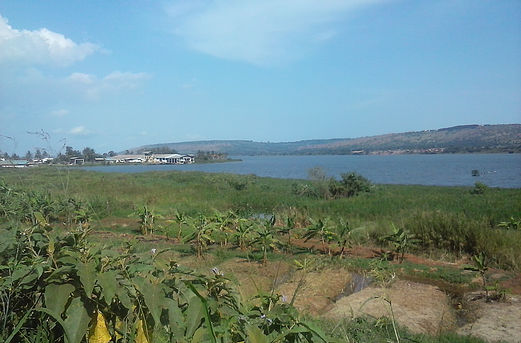
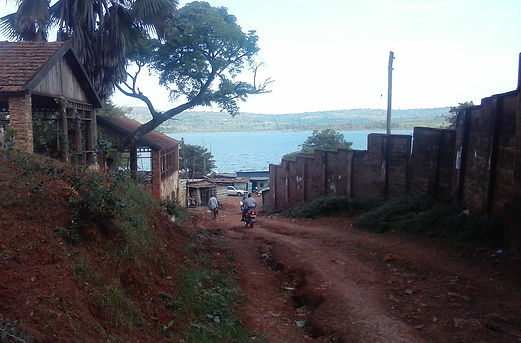
Jinja and Lake Victoria
From there I travel to a town named Mbale in eastern Uganda, near the Kenyan border. I organize a trek to the summit of Mt Elgon from there, this time from the Ugandan side. It's a simple affair – I pay the UWA (Uganda Wildlife Authority), which manages the park, and a guide will wait for me the next morning at whatever gate I decide to start from.
After consulting with the guides at the office, I decide to start the trek via the Sasa Trail and exit via the Sipi Trail. This route usually takes five days, but I compress it into four days due to lack of time (and to save money). The days will be long, both in distance and walking hours, but none of this deters me.
On the morning of the trek, I travel from Mbale to a tiny village named Budadiri. It's one of the park's entry gates and the start of the Sasa Trail. I arrive early in the morning and discover that two guides will accompany me this time instead of one, but they are still getting ready. "They'll be here very soon..." the guy at the office tells me, and I prepare myself for a wait of at least an hour – Africa Time.
Two guides sound like a blessing – two people contributing their knowledge from different perspectives, two people who can help if needed, a greater sense of security, and so on. But I am also wary – it's two against one, both speaking the same language and knowing each other for a long time, so their camaraderie is stronger, and I might end up feeling left out. Besides, I am one female with two guys roughly my age, and a trek like this invites plenty of intimate and private moments. It never bothered me to do this with a single male guide, but two men is a different game. Unfortunately, my fears come true, and even though Rogers and Karim are nice (and young) guys with good intentions overall, during the trek I felt uncomfortable with them.
The trek starts within the "community" – meaning the people and families living on the edge of the reserve. Most are farmers, and we walk past fields of onions, potatoes, and cabbage. We don't linger with the locals, who are busy at this hour farming, digging, and harvesting vegetables from the soil. Soon we enter the forest, cross the reserve border, and climb higher and higher up through Mudangi Cliffs, also known as the Wall of Death.
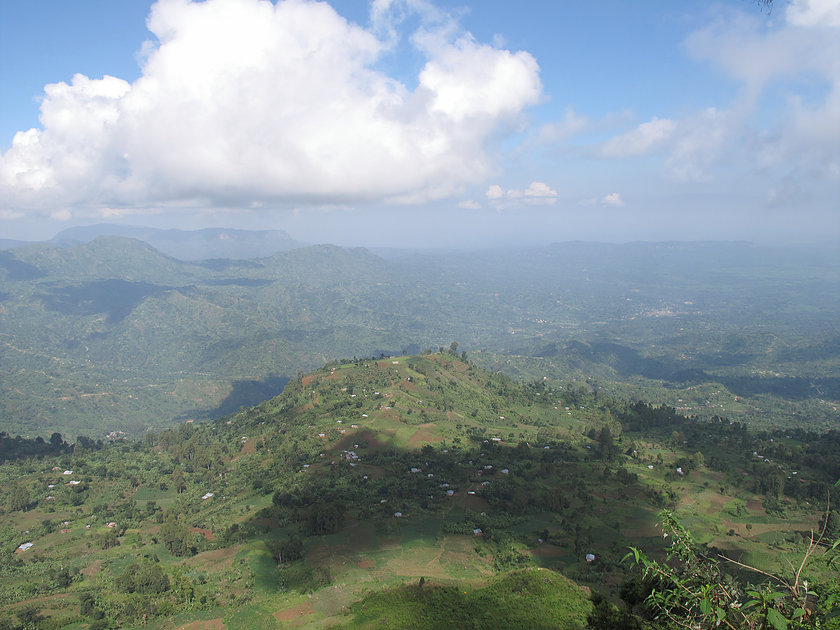
The view from the top of Mudangi Cliffs
We climb from an altitude of 1,700 m to 3,500 m, where our camp for the next two nights is located – Mude Cave Camp.
Along the way, we pass Sasa River Camp, located beside the Sasa River. After crossing it and beginning to climb, you can already see the sharp peak of Jackson's Peak (at 4,165 m), but not yet Wagagai (at 4,321 m) – the highest summit in the Mt Elgon range, still hidden behind Jackson's Peak.
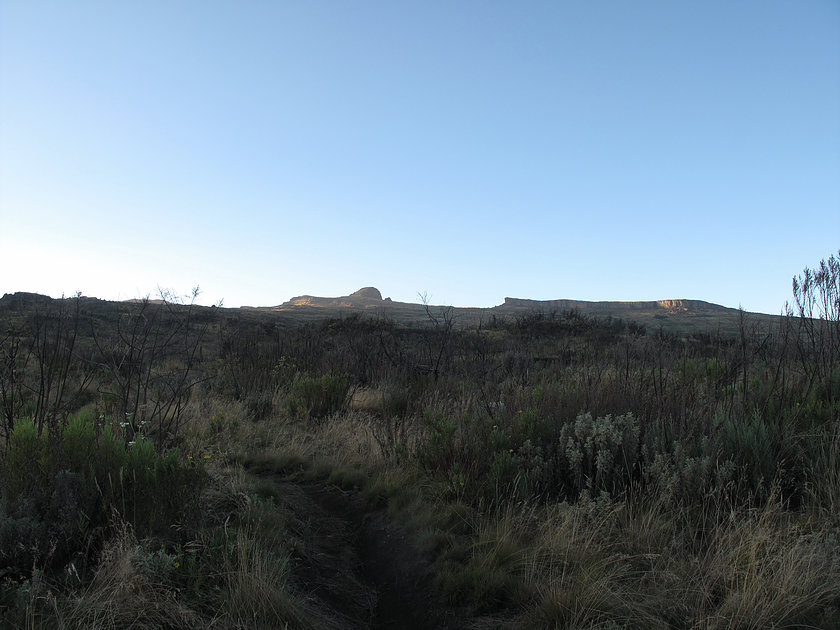
Photo caption
Jackson's Peak is clearly visible on the horizon (the bump on the left), while Wagagai is still hidden behind
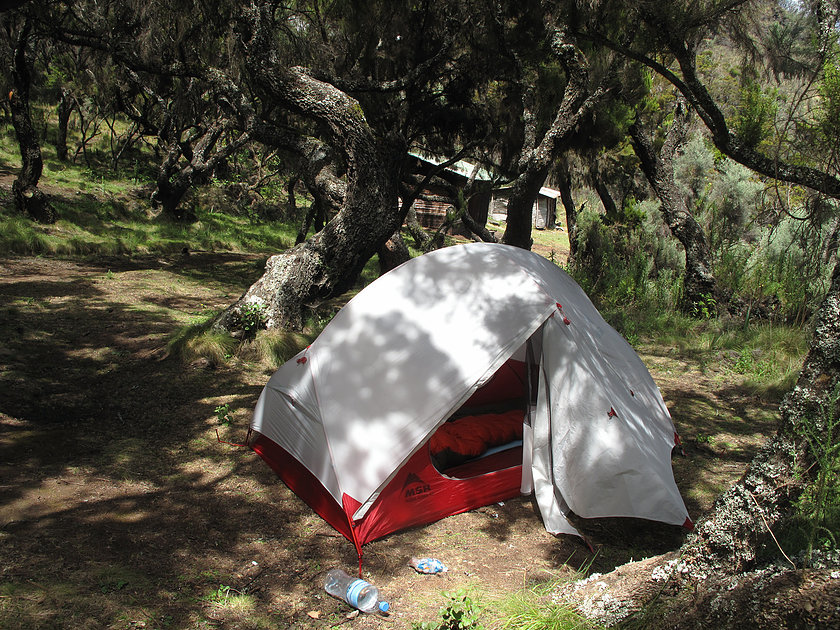
Mude Cave Camp is nestled among low, sparse trees, offering grassy spots for setting up tents and even small, basic wooden huts for the guides. The distance from here to Wagagai is only ten kilometers.
We climb to Wagagai on the second day of the trek and look out over the entire range and the massive crater of this volcano, which erupted over two million years ago. The large volcanic crater was formed after the eruption collapsed inward, creating what is called a caldera. It is the second-largest caldera in the world, stretching eight km from edge to edge. Around the caldera are the peaks of Mt Elgon – including Wagagai (at 4,321 m) and Koitoboss (on the Kenyan side, at 4,222 m).
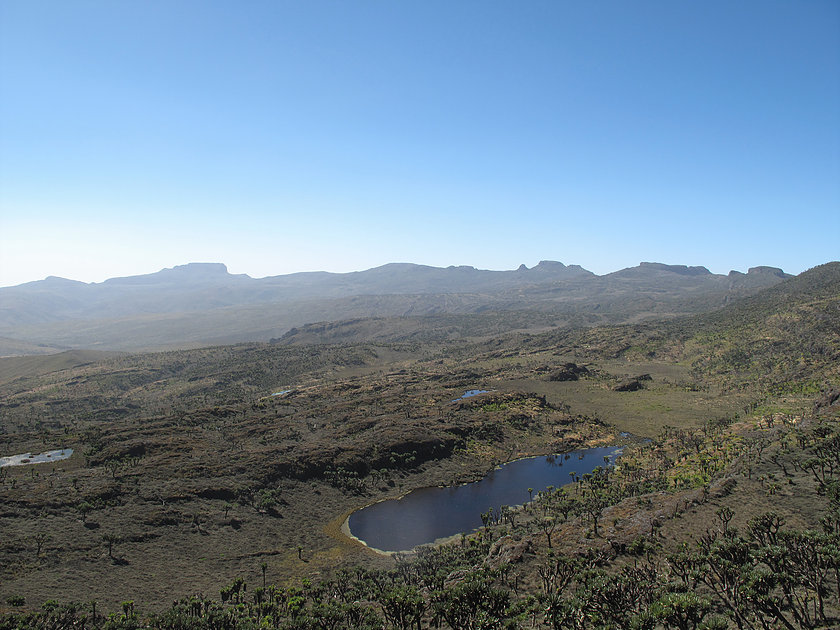
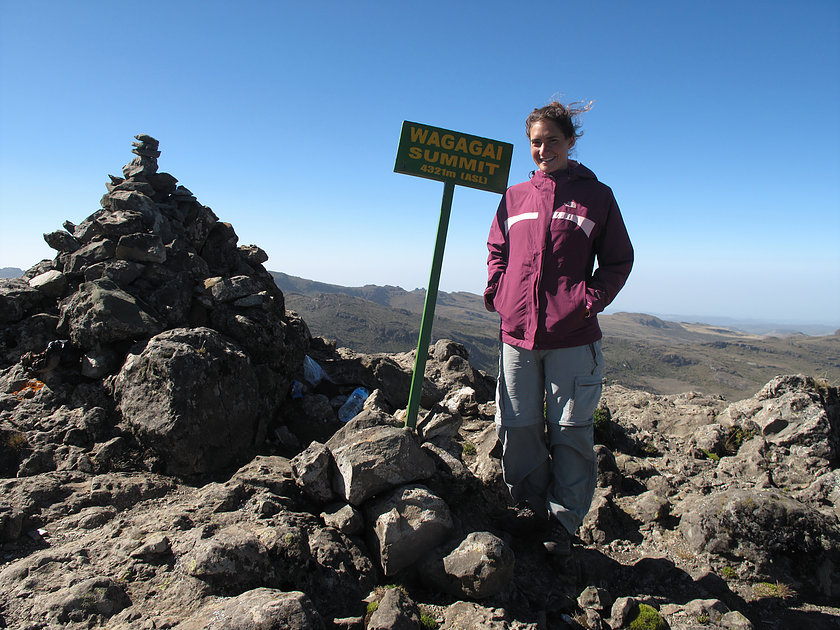
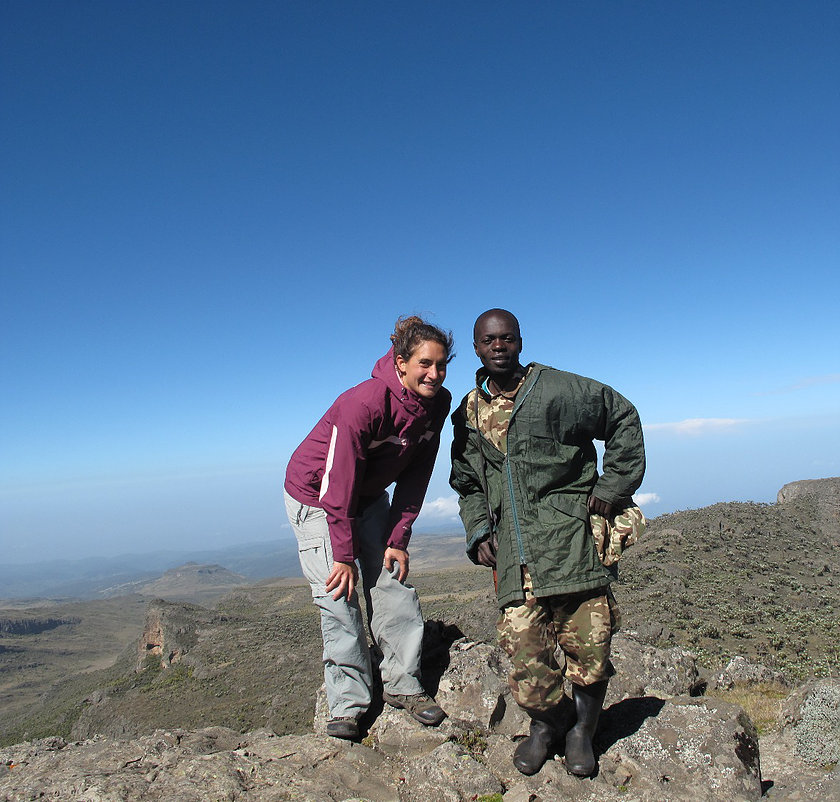
View toward the caldera and the surrounding peaks toward Kenya; Karim and I at the summit of Wagagai
From Wagagai, you can clearly see the relatively round shape of the caldera and the peaks surrounding the rim. In the center of the caldera flows the Suam River, which forms the natural border between Uganda and Kenya. I gaze at Koitoboss – just two months ago I stood on that peak on the other side of the caldera, and my heart fills with longing for Kenya, a country I love so much.
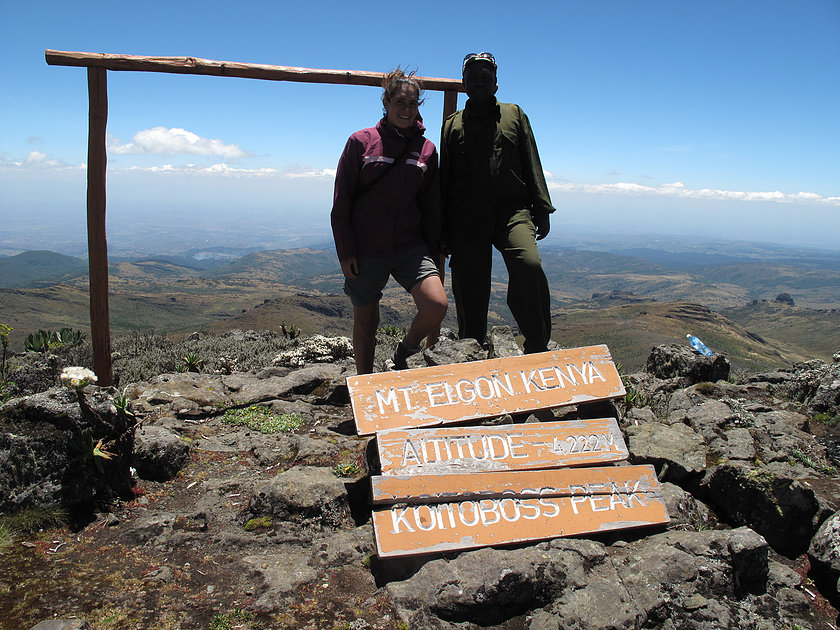
Medi and I
On the summit of Koitoboss on the Kenyan side – just two months earlier
On our way back to camp, we manage to climb Jackson's Peak as well. The British explorer who arrived in the area in the late 19th century was convinced this was the highest peak in the range and named the peak and the lake below it after himself (Jackson's Pool).
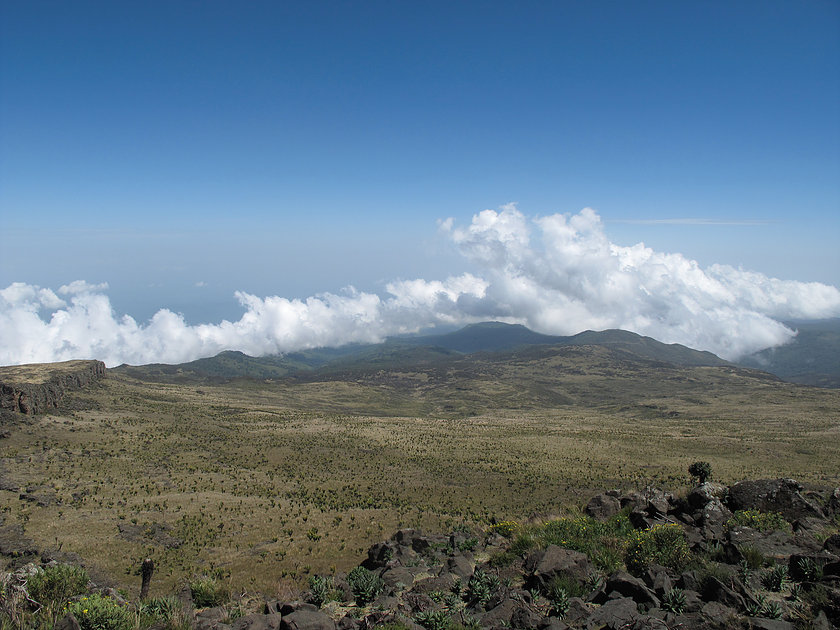
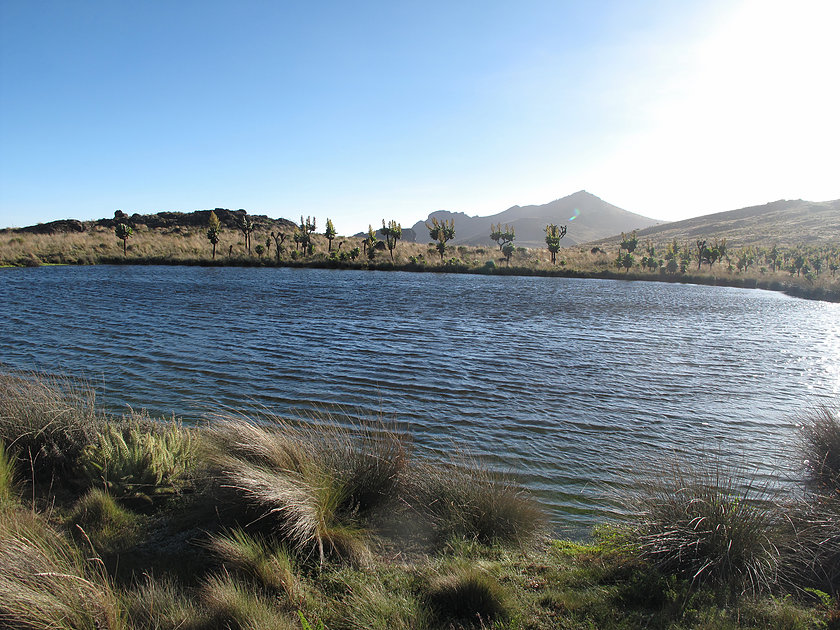
Jackson's Pool and the view from Jackson's Pool
We return to Mude Cave Camp for another night and leave early the next morning for a long 37 km day. We begin walking uphill along the edge of the caldera, through giant boulders and steep cliffs. On our way to Kajeri Camp, which marks the midpoint of the day, we pass through open, grassy areas. After a lunch break at Kajeri Camp and a dip in the adjacent river, we enter a thick bamboo forest and cross the Sipi River, which eventually cascades down to create the famous Sipi Falls (which I will reach at the end of the trek). It's a day of sharp ascents and descents. Immediately after every steep downhill comes an even steeper uphill. Only toward the end of the day do we begin descending in altitude. We sleep that night next to Tutum Cave, a massive salt cave carved into the rock. The final day is an easy, leisurely 11 km walk to the park gate. After exiting the park grounds, we walk past local homes and endless coffee crops. Most of the coffee grown here is intended for export, with very little consumed locally. The large coffee industry began with the arrival of British rule in Uganda, under their encouragement and control, and continues today as the main source of income for the local population.
Finally, we reach the tiny village of Sipi, where I bid a friendly farewell to Karim and Rogers. This tiny village is famous for a series of three waterfalls called Sipi Falls. The largest and most impressive is the third, lowest waterfall, cascading down from a height of nearly a hundred meters.
I walk down to admire this waterfall and then begin making my way back to Mbale for a cold shower (a hot shower in Uganda is a privilege...) and clean clothes.
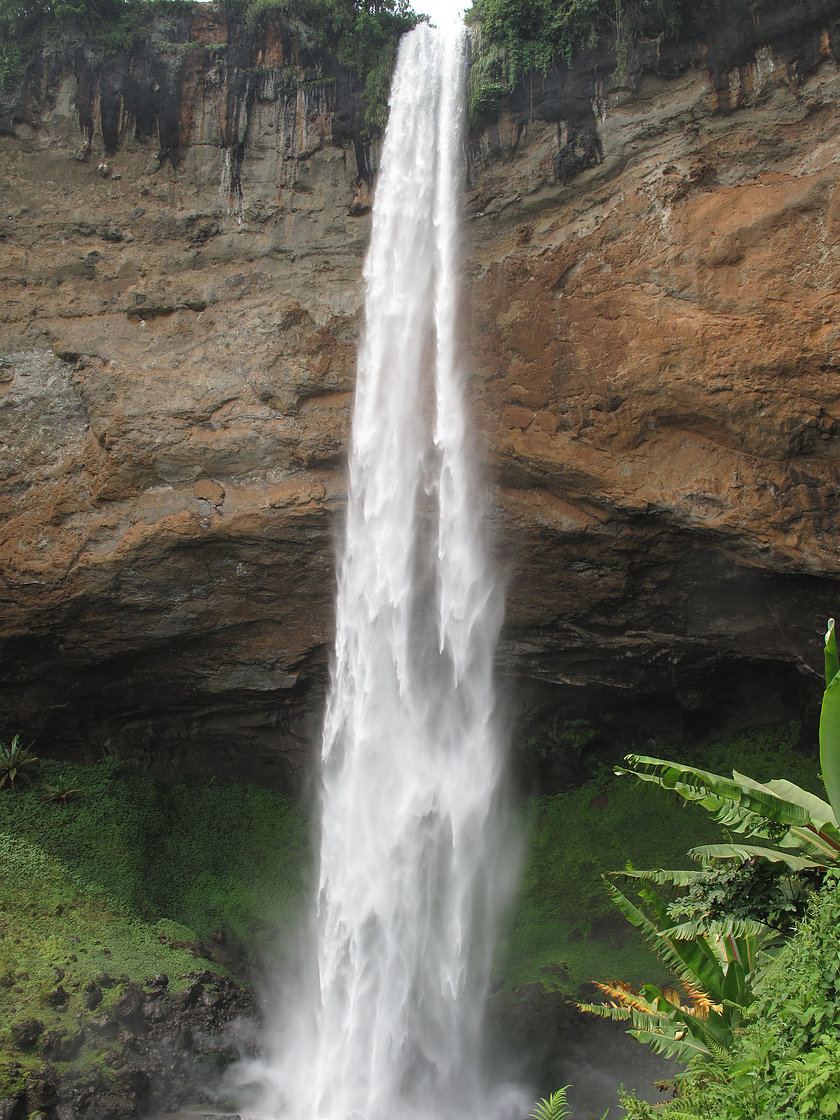
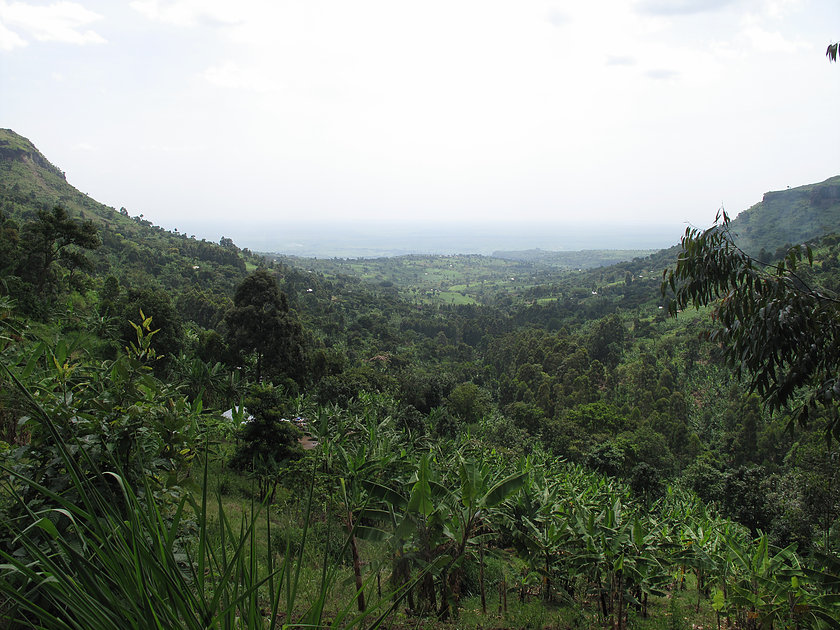
The third and largest of the three Sipi Falls
I hurry off to my next adventure because time is pressing, with only a week left until two of my older brothers land in Entebbe. I stay in eastern Uganda and decide to try my luck getting to Kidepo National Park, located in the far northeastern corner of Uganda on the border with South Sudan. I decide to take the less conventional eastern route through the region called Karamoja, inhabited by the Karamojong tribe. I didn't know much about the Karamojong or about tribal divisions in Uganda in general. The language was also a mystery to me. Before arriving in Uganda, I heard that Luganda was widely spoken, and I arrived motivated to speak with locals in their tongue. But upon arrival, I discovered that every region has its own local language spoken, and not all Ugandans know Luganda. In fact, it is not the official national language, and the only language unifying everyone is English. Indeed, most Ugandans speak English quite well, but it still felt strange to wander through an African country greeting locals in English rather than an African language, as I had gotten used to Swahili in Kenya and Amharic in Ethiopia.
I leave Mbale on a bus heading to one of the Karamojong villages called Kotido. The bus is packed to capacity – with people, bags, bananas, and even chickens. I stand at first, a doubtful pleasure during a journey of over eight hours mostly on dirt roads, but eventually a few people squeeze together in the back so I can sit too. I sit next to a guy named Hassan, an engineer by profession traveling to Kotido to install pipes to bring water into the village. He tells me about the difficulties of finding and procuring water in the Karamoja region. Beyond being an arid region with very little rain, there is also no infrastructure to capture and transport existing water. Local residents, mostly women and children, are forced to walk 3-4 km every day to find water.
Water sources are dwindling, and finding water is becoming harder. When we arrive in Kotido, I see this dry reality with my own eyes, strongly felt throughout the village.
Kotido is a dusty, hot town where you can feel the dryness in the air. In the hotel where I stay, relatively respectable compared to other options in the village (Hassan takes me there, arguing that women need a decent place to sleep, unlike men who can handle anything), there is no running tap water (despite having taps), and hotel guests receive water in buckets to bathe and use the bathroom.
It seems villagers rarely bathe, covered in dust and sand – which makes sense when you have to walk over four kilometers to find water; every drop counts and water is used for things more vital than showering.
The road leading to Kotido is a dirt road, and the roads inside the village are unpaved as well. In the main "square" there is an ATM, a true miracle to me since no power lines reach Kotido. All electricity in the village is generated by generators. When I go out in the evening to eat, it's pitch dark except for a few lit spots. I barely manage to find my way to the town center and back to the hotel.
The next morning, I get into a vehicle that takes me to Kaabong, about a two-hour drive from Kotido. It's a colorful, lively town, much more so than Kotido. It has a bustling market, and many Karamojong walk the streets. They remind me of the Samburu people I met on a trek with Ismail, as well as the Turkana people, because of their colorful body ornaments and the desert backdrop. Although I like Kaabong, I want to catch a taxi to the next town, where I'll need to arrange transport to reach Kidepo Park, as there is no public transport going to the park. The moment I place my bag on the taxi I found, a young woman named Amelia approaches me and asks if I'm heading to Kidepo. I immediately answer yes, and she says there's a vehicle going all the way to the park that can give me a ride. I am skeptical at first, assuming it's a park vehicle that will charge me a lot for the ride. She insists the ride is free, so I decide to check out the vehicle myself. I talk to the driver, and he agrees to take me happily, though there's only space in the open back of the truck, and we'll have to wait a few hours before leaving because several park employees are attending a court hearing in town, and he's waiting for it to finish to take them back to Kidepo. A few hours turned into almost the entire day, but I was actually happy to spend the day in Kaabong, meeting locals and eating local food. I ask Amelia why she approached me and helped on her own initiative. She replied that she didn't want me to get cheated or pay unnecessary money when I could easily get to Kidepo for free. She did this even though the taxi drivers were very angry with her for losing a customer. Often in Africa, I feel disheartened by people trying to overcharge me or viewing me as rich simply because of my skin color, but people like Amelia prove that good people exist in the world, lifting my spirits every time. Toward late afternoon we start driving, picking up villagers along the way for whom this is the only opportunity to travel to larger trade centers. They wait along the road and jump onto the truck as soon as it arrives.
The truck drops me off at the national park entrance, where the main staff camp is located, but the camp where visitors can stay is another twenty kilometers away. That day I realized that sometimes you need more luck than brains (and luckily I have plenty of luck): just as we arrive at the park entrance, another vehicle leaves, taking me all the way to Apoka, the reserve's main camp with a series of Bandas (round mud structures with steep thatched roofs) and a large camping lawn.
I set up my tent near the bathrooms, but the reserve staff advise me to move closer to the office building because an elephant, the camp's "pet," frequently wanders around the bathrooms and campsite area. Unlike in South Africa, Uganda's national parks have no fences, not even around accommodation areas inside the reserves. So our camp is completely open, and over the next few days in Kidepo, animals visit the camp area throughout the day – elephants, giraffes, zebras, warthogs, and waterbucks. Some say lions even come at night, but fortunately no lion tried to enter my tent during the nights I slept there.
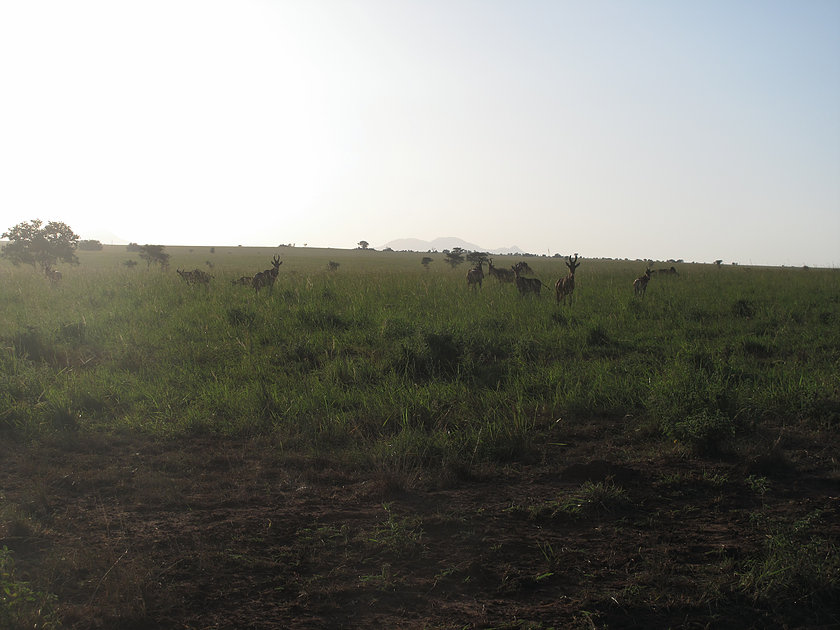
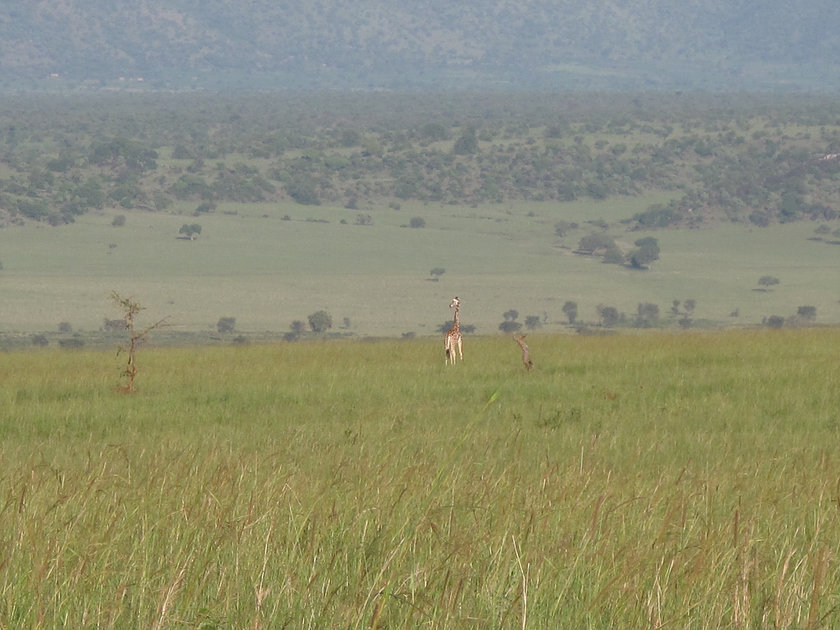
Animals in Kidepo National Park: giraffe, Jackson's Hartebeest, buffalo, Springbok
Other tourists are staying at the camp at the same time. I make friends with them, and they invite me to join their game drives to spot wildlife. I meet the camp manager, who is impressed that I'm traveling solo and managed to reach the camp on my own. He offers to move me to one of the Bandas (round mud structures with thatched roofs, typical of Africa) for the price of camping. I accept the offer, once again reminded of how many good people exist in the world (and it seems many of them are in Africa)!
After a few days at the camp, one of the tourist groups heads to Kampala, and I ride along with them. At night, we stop to sleep in a town called Gulu. I return to Kampala and meet Medi again. He welcomes me with joy and warmth, and even though Kampala isn't my favorite place, I feel I've reached a familiar and safe spot thanks to Medi. A bit like home. Only a few days left to wait until I feel what a real home is like – when I welcome two of my older brothers at Entebbe airport.